
Hastings City Directory Collections
Hastings city directories survive in overlapping collections, not in one seamless run. The Adams County Genealogical Society reports Hastings volumes from 1882 to the present, while the Hastings Public Library describes a sporadic 1891 to 1960 run. Omaha Public Library holds a separate microfilm sequence, and the Nebraska State Genealogical Society catalog records selected years. Treat each year as a separate edition. A missing year at one library does not show that the book was never published or that a person was absent from Hastings.
| Collection | Years | Where Held | Access |
|---|---|---|---|
| Hastings directories | 1882-present reported | ACGS at Hastings Museum | Onsite society collection |
| Hastings directories | 1891-1960, sporadic | Hastings Public Library | Library holdings and research help |
| Hastings microfilm | 1891-99; 1903-15; 1917-26; 1928-35 | Omaha Public Library | Microfilm collection |
| Cataloged Hastings editions | 1895, 1898-99, 1899, 1961, 1968, 1975-79, 1994 | Nebraska State Genealogical Society | Catalog and onsite access |
The public catalogs do not identify one publisher for every Hastings volume, so a label such as Polk should be used only when it appears in the edition itself. The national U.S. City and Business Directories collection is another lead, with an approximate 1749 to 1990 span, but business names may not be indexed. Search a surname, given name, city, and year separately, then inspect an available image.
Hastings Library Directory Research
The Hastings Public Library genealogy service combines the directory shelf with in-library Ancestry Library Edition and federal census images and indexes. The library is at 314 N Denver Ave and can be reached at 402-461-2346. Hours listed in the local research material are Monday through Thursday, 9 a.m. to 7 p.m.; Friday and Saturday, 9 a.m. to 5 p.m.; and closed Sunday. Those hours make the library a practical first stop when an online name search leaves a year gap.
Its library FAQs add the Hastings Tribune on microfilm from October 2, 1905 to the present, Nebraska census years 1900, 1910, 1920, and 1930, and obituary help by phone, email, or in person. The Tribune is an Adams County source, not a full substitute for civil records. Microfilm may also be ordered through interlibrary loan, and patrons can bring their own film.
For a view of the alternate regional run, see the Omaha Public Library city-directory collection.
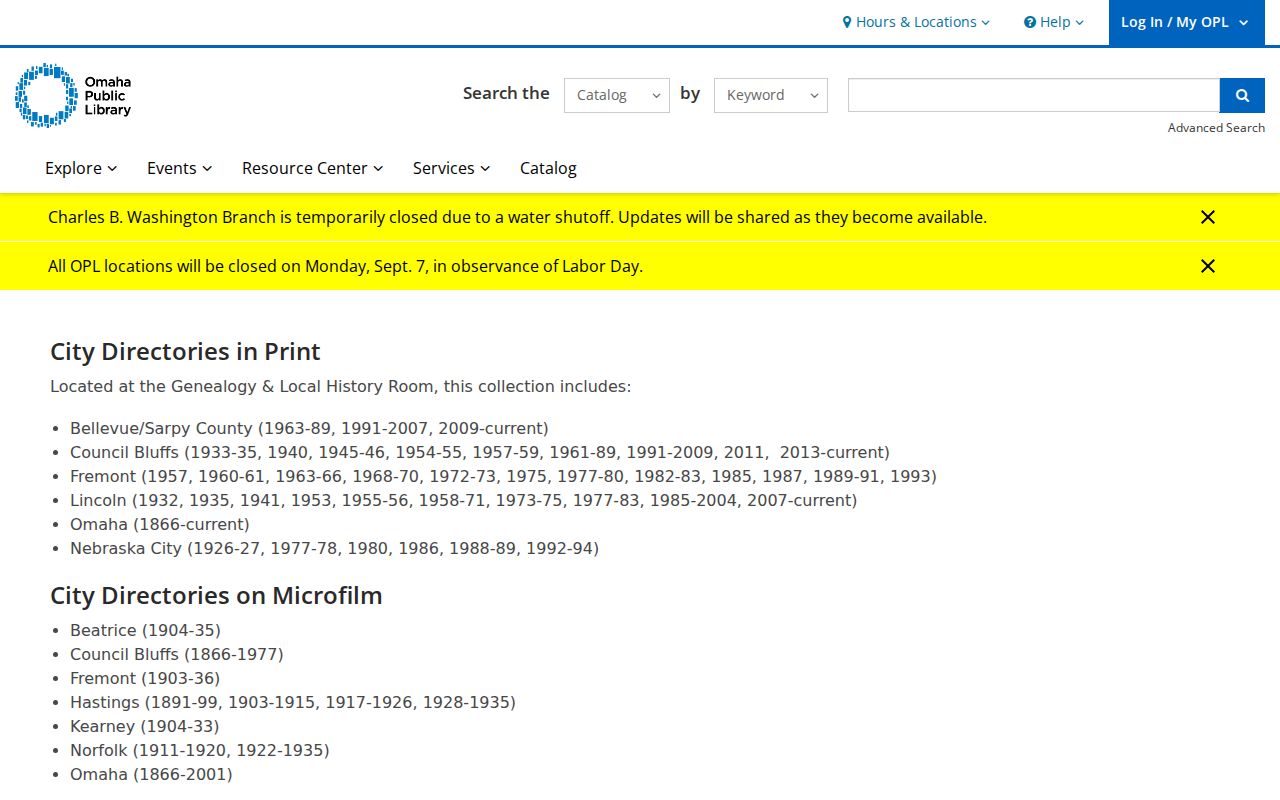
Its dates show why a gap in one source should send a researcher to another Hastings repository, not end the search.
Hastings ACGS Directory Holdings
The Adams County Genealogical Society, established in 1968, keeps its library in the Adams County Historical Society at Hastings Museum. It reports Hastings City Directories from 1882 to the present, plus an Adams County marriage-license index for 1871-1972, school census material for 1876-1920, naturalizations for 1871-1929, 62 church holdings, and an 18,000-image photo index. These companion sources help test whether a directory name, address, or relationship fits the right person.
The listed hours are Tuesday through Thursday, 10 a.m. to 4 p.m.; Friday, 9 a.m. to 1 p.m.; and Saturday, 10 a.m. to 3 p.m. Its county census holdings for 1870, 1880, 1885, 1900, 1910, and 1920 are unindexed, so bring a name variant, likely date, and an address or district if known. The society also lists regular research-oriented meetings at the library on selected fourth Tuesdays.
The society's holdings list shows the breadth of the local historical shelf.
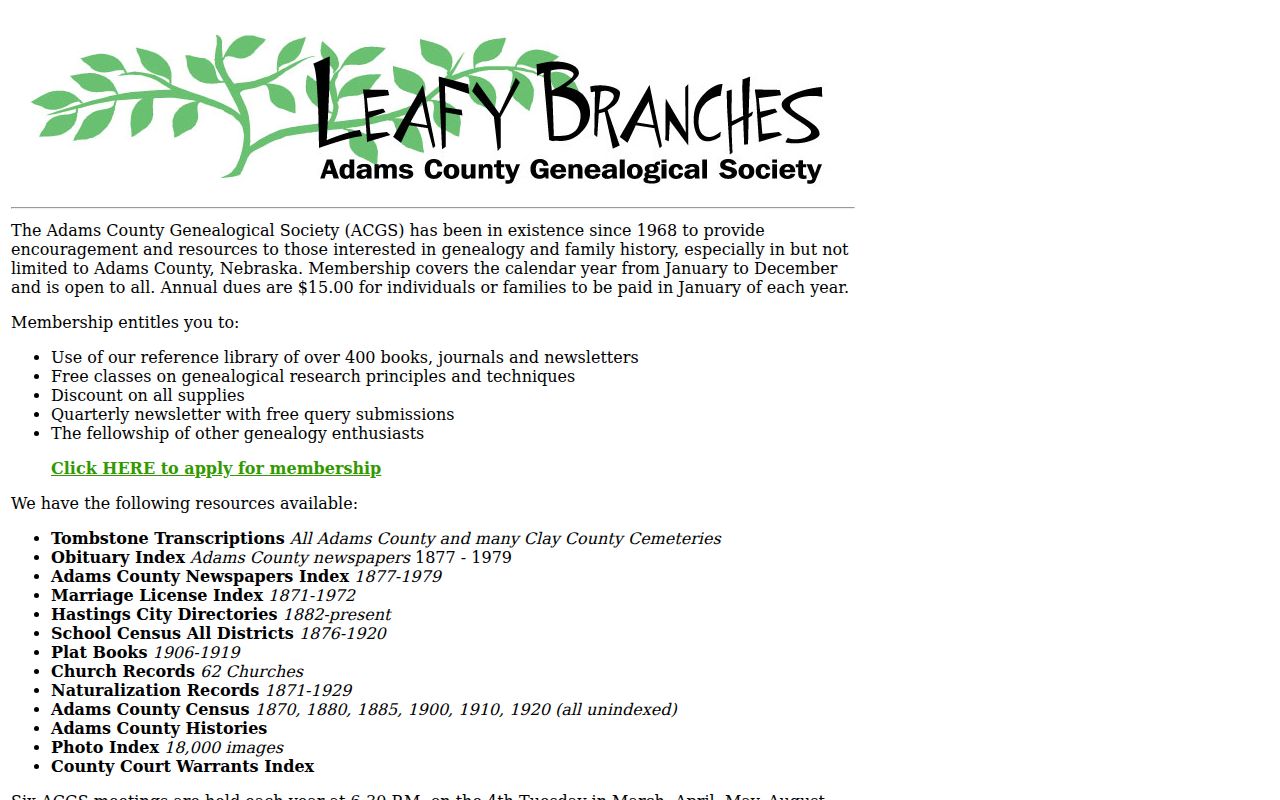
Use a directory edition as one dated source, then pair it with the relevant ACGS index or collection rather than treating it as a complete life record.
Reading a Hastings City Directory
No named-person entry was retained in the research, so the fields below are an inspection checklist rather than a reproduced sample. The layout and abbreviations vary by edition. Photograph or transcribe the volume's abbreviation key before expanding initials, relationship marks, or address shorthand. A street listing and alphabetical listing should agree on address, initials, spouse notation, or continuity in the next available year before they are treated as the same person.
| Name | Surname, given name, initials, and any relationship notation printed with the entry. |
|---|---|
| Address | House number, street, and a separate business or office address when the volume gives one. |
| Family notation | Spouse in parentheses, widow notation, or another relationship clue if the edition uses it. |
| Role or business descriptor | A printed activity, firm, or other identifying description that can separate people with the same name. |
| Edition evidence | Directory title, year, page, section, publisher if printed, and any owner notation used by that volume. |
- Criss-cross section
- The street-order portion of a directory, used to approach an address before returning to the alphabetical entries.
- Householder index
- An index arranged around the person or household named at an address, not proof of every person present there.
- Abbreviation key
- The edition's legend for initials and short forms. It is usually near the front and should be captured before interpreting entries.
Hastings Directory Years and Gaps
The surviving runs line up with a broader local record history. The first reported ACGS directory year predates statewide birth and death registration, which began in 1904. The library's Tribune microfilm begins in 1905. That sequence gives a researcher several ways to test an early address, but it also means a source may be silent for reasons unrelated to the person being researched.
| 1877-78 | Adams County's seat moved from Juniata to Hastings in the railroad-junction era. |
|---|---|
| 1882 | Earliest Hastings directory year reported by ACGS. |
| 1891 | Beginning of the documented Omaha microfilm period and the library's sporadic directory era. |
| 1905 | Hastings Tribune microfilm begins on October 2, adding a dated newspaper check. |
| 1961-1994 | NSGS catalog records selected later Hastings directory editions, including 1961, 1968, 1975-79, and 1994. |
The Nebraska State Genealogical Society catalog supplies those later edition leads.
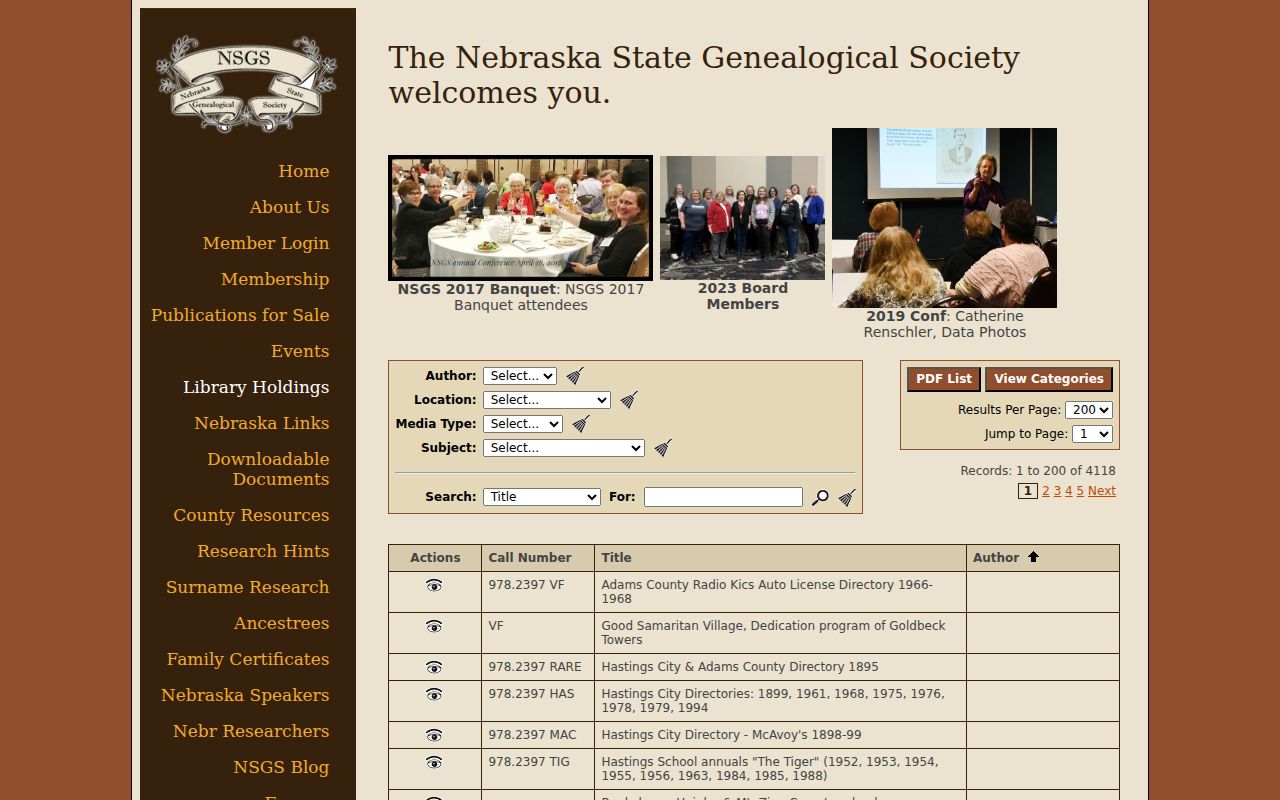
Catalog dates identify volumes to request or inspect; they do not fill the unlisted years between them.
Hastings Sources Beyond Directories
A directory entry gains weight when another dated source supports it. ACGS has unindexed county census years and a marriage index, while the library's Tribune microfilm can test notices, obituaries, and organization references after 1905. History Nebraska identifies Hastings First Baptist Church records, 1873-1964, as RG4085. The church-record finding aid is collection-level evidence, so request by church, date range, and name rather than assume a full online index exists.
For a historical address, the 1899 Library of Congress Sanborn set has 15 public-domain sheets. It can show street labels, blocks, building footprints, and businesses around an address. It does not identify everyone at the address. Use it to reconcile the physical place before matching it to a Hastings directory entry.
Note: A historical directory identifies a printed entry for one edition and should be cited with the year, page, repository, and section.
Tracing a Hastings Household
Work from a dated edition rather than a broad name search. Record what the volume actually says, including spelling, initials, address, section, and page. Then move to the next available Hastings city directory, even when several years have passed. A move, a changed initial, or a new family notation can distinguish same-name entries. Federal and county census material can bridge the longer gaps, while the Tribune and local indexes can test a departure, death, or organization reference.
- Locate the likely name or street in one edition and note the full citation, address, and section.
- Check the next available edition for continuity, a changed address, a spelling variant, or a changed family notation.
- Use the criss-cross section only when the volume has one, then verify the address against the alphabetical entry.
- Compare the dated trail with the local and federal census years held through ACGS and the library.
- Use Tribune microfilm, obituary help, church material, a plat, or a Sanborn sheet to test a significant change.
A disappearance can reflect a move, a death, a missed edition, an indexing issue, or a different form of the name. It is not a final conclusion. When the goal shifts to modern address-keyed records, the Hastings street directory has the current parcel and street workflow.
Hastings Digital History Sources
The Hastings Public Library collection in Nebraska Memories provides digital local-history material, including the 1906 Book of Hastings and the Children's Blizzard reunion material for 1888-1938. These books can supply the local institutional or community context around a directory name. They are not a substitute for a dated directory page, but they can point to a newspaper issue, a street, or another collection to check.
The collection also carries a rights statement: its images are owned or copyrighted by the library and may not be copied, printed, or distributed illegally. Use the individual item page for its citation and rights information before reproducing any image.
See the Hastings Public Library digital collection.
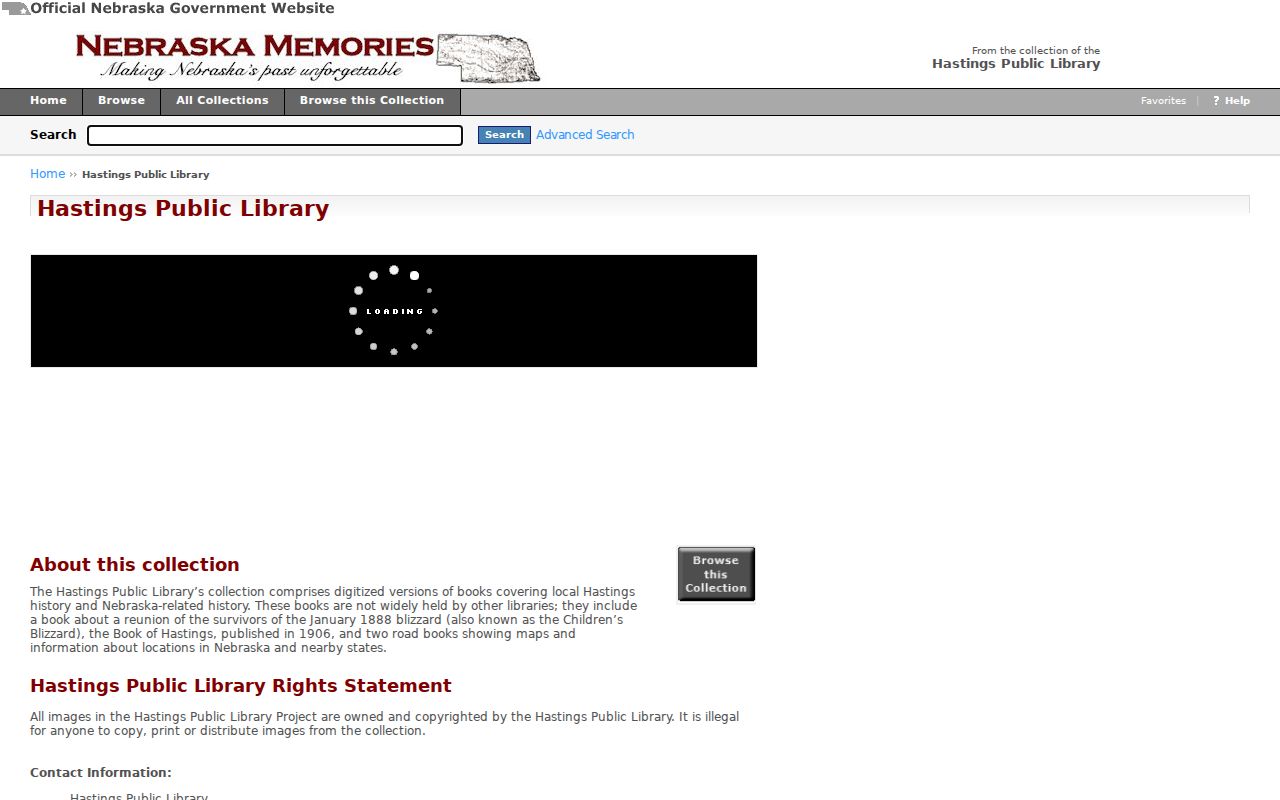
Digital books are most useful when their place names or institutions can be checked against a dated directory, map, or newspaper source.
Hastings County-Seat Record Shift
Early Adams County research can lead outside the later Hastings filing pattern. The city history timeline places incorporation in 1874, while History Nebraska explains that the county seat moved from Juniata to Hastings in 1877-78 because of the railroad junction. A person connected to the earliest local period may therefore appear in Juniata, county, church, cemetery, or railroad-era material before a Hastings directory becomes useful.
The History Nebraska account of Adams County's Michigan Colony supplies the county-seat context. It is a good reminder to search a place name as carefully as a surname when working before the city directory era.
Hastings City Directory Boundaries
Directory entries are historical leads, not a current identity record. A printed address may be stale, a person may be listed in more than one role, and a business name may not be indexed in a digital collection. Keep the directory label precise: alphabetical entry, street entry, business entry, or institution. Do not turn a single record into a claim about a person's present location or family relationship.
Library patron and circulation records are protected under Nebraska public-record exemptions and are not a directory resource. For respectful historical research, use the published holdings, request only a defined item or date range, and preserve the source citation for each claim.